The Breeze
Private · Empire Edition
Hash check · Session in localStorage
pottery.b3rt.dev · Vol. I 9 entries · NC High Country · 2026

A B3RT Editorial Ledger · Issue No. 1

Clay, Ash & Albemarle.


Source: Pexels · CC

Source: Flickr · CC

Source: Pexels · CC

Source: Pexels · CC

A working record of the people who throw, coil, glaze, and fire in western North Carolina — what they pull from the ground, what they cook it with, and why the work outlasts the season.

01

The western North Carolina folk-pottery tradition.

Three names — Jugtown, Seagrove, the High Country — describe one continuous tradition that has been firing stoneware in the same drainage since before the Revolution.

Western North Carolina has been a pottery region since the 1760s. The earliest documented kilns in the Catawba and Yadkin valleys date to that decade; by the 1820s the round-bellied alkaline-glazed jug of the Piedmont was being hauled by mule to Augusta, Charleston, and the lower Cape Fear. What is now called folk pottery — wheel-thrown or coiled stoneware, wood-fired, ash-glazed — is the direct descendant of that trade. It never stopped; it slowed, consolidated, was revived, and remains one of the longest unbroken craft lines in Anglo-America.

Jugtown

Jugtown is the place-name for kilns along Jug and Little Long creeks in Moore County from the 1820s through the 1940s. The tradition was Anglo-derived, descended from potters who had worked the alkaline-glazed ware of the Edgefield District in South Carolina. After the Second World War, the Jugtown potteries consolidated under Jacques and Juliana Busbee, who reframed the work as studio craft. Their successor Ben Owen Sr. kept the line alive at Jugtown Pottery from 1959 until 1983; Ben Owen III continues at the same bench today.

Seagrove

Seagrove, fifteen miles north of Jugtown along the same railroad grade, is the commercial name for the same pottery corridor in Randolph County. The Seagrove potters' cooperative has organized studio tours since 1983; the corridor now lists more than 100 working potters. Jugtown and Seagrove are not separate traditions; they are two stops on the same road.

The High Country

The High Country — Avery, Watauga, Mitchell, Ashe, Yancey — has never been a Jugtown-scale corridor. What it has is clay (mica-rich stoneware dug near Spruce Pine), fuel (oak and poplar cordwood), and the Penland School of Craft, founded in 1929. Penland is the single most important reason the craft survives in the mountains: nearly every working studio potter in the High Country can trace training back to a Penland workshop.

Sources & Further Reading

  1. Pottery
    https://en.wikipedia.org/wiki/Pottery
    Pottery is the process and the products of forming vessels and other objects with clay and other raw materials, which are fired at high temperatures to give them a hard and durable...
Coil-built earthenware vessel.
Kick wheel & clay.
Wood-fired, side stoke.
02

The Cherokee pottery tradition.

An older, separate line — coiled, paddle-impressed, wood-fired, and made without a potter's wheel until the 20th century.

The Eastern Band Cherokee pottery tradition is the oldest continuous ceramic tradition in the eastern United States. It predates European wheel-thrown pottery by at least a thousand years and was made by hand-building coils, paddling the surface with carved wooden paddles (often wrapped in corn husk to leave a textured finish), and burnishing before an open-pit wood firing. Pots stored corn, beans, river cane, and hominy.

The Eastern Band

The Eastern Band of Cherokee Indians, federally recognized since 1868 and based on the Qualla Boundary in Swain and Jackson counties, has maintained the pottery tradition continuously. The named lineage runs through the Cherokee National Treasure medallion holders: Amanda Swimmer (1921–2014), her daughter Ramona Lossie, Marie Z. Cochran, and the contemporary potters at the Qualla Arts studio. Western Cherokee pottery, in the Oklahoma Nation, also survived the Trail of Tears; Quay Tahchee kept the line alive there for decades.

Why a separate section

Cherokee pottery is not a subdivision of Anglo folk pottery. The two traditions share a kiln (wood), a glaze (ash), and a fuel (oak cordwood); they do not share a forming method, surface treatment, or ceremonial context. The Cherokee line is named here and respected as a parallel rather than a subset.

03

Clay: what is dug, ground, and shipped.

The three families of clay that drive the western NC pottery tradition: local stoneware, slip clays, and prepared commercial bodies.

Clay bodySourceCharacterUsed for
Mica stonewareNative to Spruce Pine, NC areaGrey-to-buff, coarse, mica-fleckedWood-fired stoneware, salt glaze, traditional Jugtown forms
Albermale (Albemarle) stonewareStanly County, NC pit clayPlastic, fires grey to off-whiteWheel-thrown stoneware, slip-cast and thrown production
Albany slipOriginally Albany, NY (now mostly synthetic)Dark brown, iron-rich, plasticSlip-trailed decoration, interior liner under ash glazes
Bristol slipEngland (now prepared in US)Red-to-brown iron slipInterior liner for Anglo-American folk ware
Black mountain clayMadison County, NCPlastic, fires dark brownBurnished ware, slip decoration, Raku bodies
Prepared porcelainCommercial (Standard, Laguna)White, dense, vitreousStudio porcelain, electric kiln, Cone 10 reduction-mimic
Local earthenwareVarious riverbanks, regional pitsRed-firing, low-fire (cone 04–06)Planters, slipware, low-fire raku bodies

The mica question

Western North Carolina stoneware clays are distinguished by their visible mica content. The mica is muscovite from the parent granite of the Spruce Pine pluton; it survives grinding as flat reflective platelets that sparkle unfired and, more importantly, melt into the glaze surface during a long wood firing. The mica is the reason a wood-fired jug looks the way it does. Prepared commercial bodies must be augmented with grog and synthetic mica to recover the surface character, and they never quite do.

04

Forming: coil and wheel.

The two physical methods. Most High Country potters use both; the choice of method is the first design decision of any piece.

Wheel throwing

Wheel throwing is the Anglo-American studio pottery default. A centered ball of wedged clay is opened, pulled up into a cylinder, and shaped under centrifugal force. Throwing is fast (a 12-inch bowl in three minutes), reproducible, and dependent on a well-tempered body. Almost every commercial potter in the corridor throws.

The trap of throwing is that every piece looks like every other piece. The best thrown pottery is shaped; the worst is merely pulled.

Coil building

Coil building is the older method, predating the wheel by millennia in the Americas. Soft ropes of clay are stacked, welded together with pressure, and scraped or paddled smooth. Coil-built forms are slower (a 16-inch vessel takes two hours), more sculptural, and structurally superior at large scale. The Cherokee tradition is exclusively coil-and-paddle; contemporary High Country potters have returned to coiling for monumental work and for forms that cannot be thrown.

The trap of coiling is the seam: visible weld lines are a tell, hidden weld lines are a structural liability.

05

Firing: wood, salt, soda, raku, and electric.

Each firing method is a different kiln, a different fuel, and a different glaze chemistry. The list below is in order of the surface character they leave on the pot.

  1. Wood firing

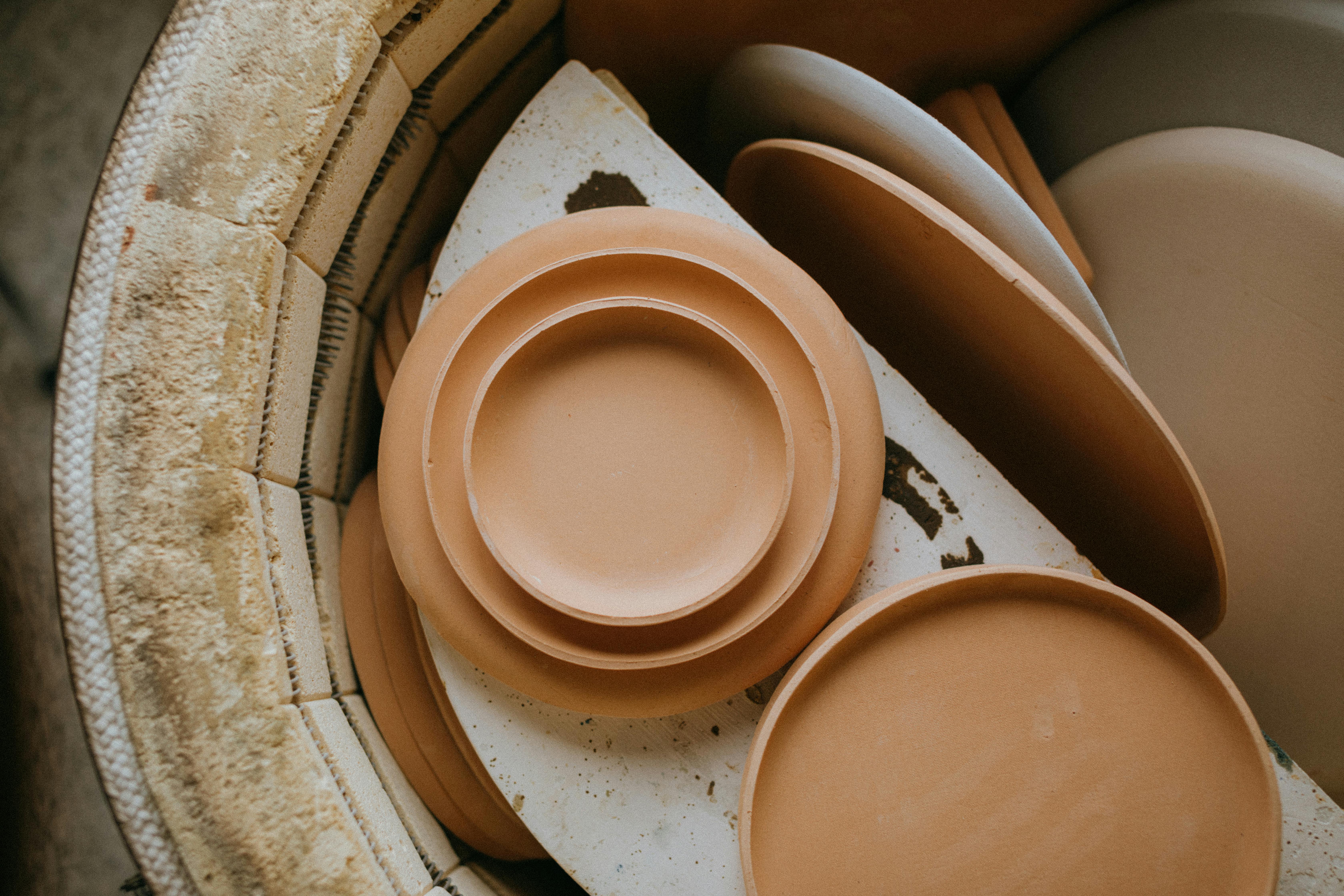
    The oldest method still in regular use in the region. A wood-fired stoneware kiln is loaded with pots, sealed with brick and refractory mortar, and stoked continuously for 24 to 72 hours with cordwood (oak, poplar, hickory). Temperatures reach cone 10 (around 2,300°F); ash from the fuel settles on the pots and melts into the surface, leaving an orange-to-grey flashing no other method replicates. The Jugtown, Seagrove, and High Country traditions all run on wood.

  2. Salt firing

    A soda-salt glaze is introduced into the kiln at peak temperature by shoveling coarse rock salt into the firebox. The salt volatilizes, combines with silica and alumina in the clay body, and deposits an orange-peel sodium-silicate glaze on every surface exposed to the vapor. Salt firings reach cone 9–10 over 18–24 hours. The signature surface is the orange-peel "orange skin" texture and the dribble marks where salt-laden vapor condensed.

  3. Soda firing

    The soda variant replaces salt (sodium chloride) with soda ash (sodium carbonate), often mixed with bicarbonate or bicarbonate-borax blends. Soda firings produce a slightly more matte surface than salt, with characteristic drips of glossy transparent glaze over a warmer base. Soda firing is gentler on kiln brick and is preferred for kilns designed to run both methods.

  4. Raku

    Raku is a low-fire (cone 06, around 1,800°F) rapid firing originally developed in 16th-century Japan for tea ware. The piece is removed from the kiln at red heat and reduced in a sealed container of combustible material — sawdust, newspaper, leaves — to produce a crackled, smoky, often-metallic surface. Western North Carolina raku tends toward the decorative end of the spectrum. Raku pots are not functional in the kitchen sense.

  5. Electric firing

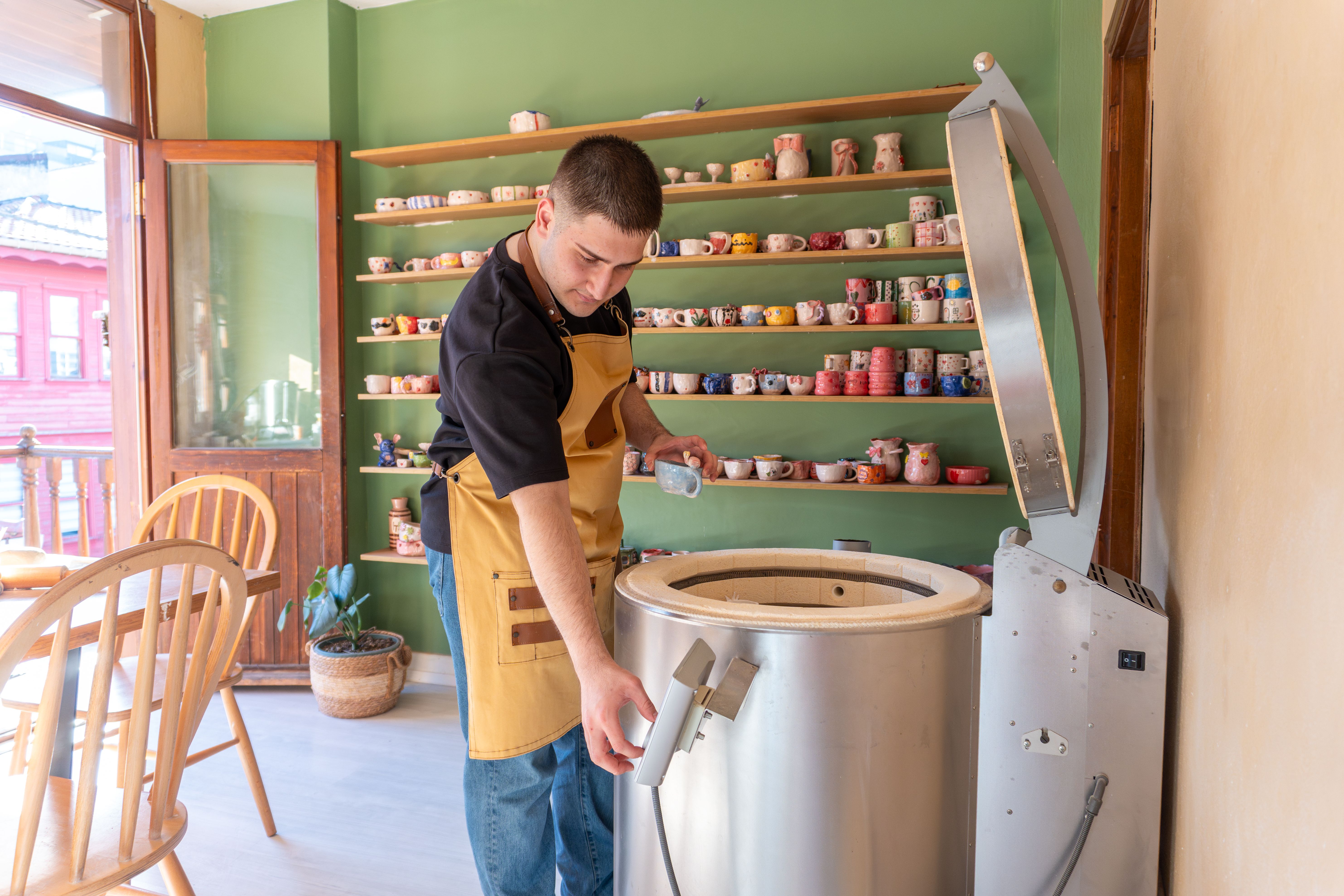
    Electric kilns fire oxidation only — no flame path, no vapor glaze, no ash. The trade is control: a clean oxidation atmosphere, repeatable temperatures, and a kiln that fits in a 10x10 studio. Most studio production in the High Country is electric-fired to cone 6 or cone 10 with prepared commercial glazes. Electric ware looks clean and contemporary; it does not look wood-fired, and should not be sold as such.

06

The regional schools.

Three residential craft schools within a day's drive of Newland have produced nearly every working studio potter in the western NC corridor.

SchoolPenland School of Craft LocationPenland, Mitchell Co., NC Founded1929 (as Penland School of Handicrafts) Distance22 mi from Newland

The Penland pottery tradition.

Penland is the dominant factor. Founded in 1929 by Lucy Morgan, Penland added clay in the 1960s and built its first dedicated clay studio in the 1970s. The program runs 15–20 workshops a year, hosts a two-year residency, and operates a production studio with four gas kilns and one wood kiln. The list of working North Carolina potters who taught or studied at Penland is the list of working North Carolina potters.

SchoolArrowmont School of Arts and Crafts LocationGatlinburg, TN Founded1912 Distance110 mi from Newland

Arrowmont and the Appalachian convergence.

Arrowmont sits across the state line in Gatlinburg but draws heavily from the same western NC population. Its clay program runs concurrent with Penland's, and several instructors teach at both. Arrowmont's contribution is its week-long workshop structure and its stronger fiber and surface-design program.

SchoolJohn C. Campbell Folk School LocationBrasstown, NC Founded1925 Distance75 mi from Newland

The Folk School clay studio.

The John C. Campbell Folk School is the oldest residential craft school in the Southeast and the most accessible to beginners. Its clay program emphasizes hand-building, slip trailing, and the functional surface treatments of the Anglo-American tradition — not the studio-throwing focus of Penland. Its influence on the region's potters is sustained public engagement with the craft.

07

Glaze chemistry and surface decoration.

Three families of decoration (decals, slip trailing, luster) and the glaze chemistry that makes them work.

Slip trailing

Slip trailing is the Anglo-American folk pottery default. A liquid clay slip (typically Albany or Bristol) is applied to the leather-hard pot through a fine nozzle, in lines, dots, and calligraphic gestures. The slip fires into the body and survives functional use. The Jugtown tradition of freehand slip-trailed decoration — "crawl," "loop," "splash" — is the most recognizable surface in the western NC folk style.

Decals

Ceramic decals are printed images on a water-soluble film, applied to the glazed and fired surface, then re-fired at low temperature to fuse into the glaze. Decals allow photographic and typographic imagery impossible by hand. In the High Country tradition, decals are used most often for the maker's mark. Underfired decals wear off; overfired decals burn out.

Luster

Luster is a metallic overglaze fired in a third, very-low-temperature firing (cone 018 or below). It contains precious-metal salts — gold, platinum, silver — in an oil and resin medium that burns off and leaves a metallic film. Luster is decorative, not functional. Potters reserve it for commemorative work.

Glaze chemistry, briefly

A glaze is a thin glass, melted onto the clay body in the kiln. Every glaze is built from three components: glass formers (silica), stabilizers (alumina, which keeps the glass from running), and fluxes (soda, potash, calcium, boron — the low-melting materials that let silica melt at kiln temperature). The Seger unity formula — RO:Al₂O₃:SiO₂ in molar ratios — is still how a glaze is designed on paper. The wood-fired ash glaze is the simplest: just wood ash, melted onto the pot by the kiln's own heat.
08

The potters worth knowing.

A working roll of named potters in the High Country and the wider western NC region. Visit a maker before commissioning based on a name alone.

MakerDaniel Johnston LocationBakersville, Mitchell Co. SpecialtyWood-fired stoneware, salt glaze Era1980s – present

The Bakersville wood fire.

Daniel Johnston has fired an anagama-style wood kiln in Bakersville since 1986. His production is small — fewer than 800 pots a year — and his pots are the textbook example of western NC wood-fired stoneware: ash glaze on the shoulders, firebox-side flashing, unglazed clay foot. Johnston taught at Penland for two decades; his students run shops from Burnsville to Marshall.

MakerMark Hewitt LocationPittsboro, NC (originally from England) SpecialtyAlkaline-glazed stoneware, large-scale Era1983 – present

The Alkaline revival.

Mark Hewitt moved to North Carolina from Stoke-on-Trent in 1983 to work with Jugtown potter Ben Owen Sr. He stayed, opened production in Pittsboro, and over forty years has become the most visible interpreter of the alkaline-glazed Anglo-American stoneware tradition. His storage jars — 3 to 30 gallons, slip-trailed, wood-fired — are the largest consistently produced since the Edgefield District shut down.

MakerBeth Goreham LocationSeagrove, Randolph Co. SpecialtyFunctional stoneware, electric and gas Era2000s – present

The Seagrove functional.

Beth Goreham represents the contemporary studio-craft generation in Seagrove: a Penland-trained wheel thrower producing high-fired stoneware for the kitchen and table. Her signature forms are dinnerware sets and serving bowls with brushed-on shino and tenmoku glazes. Where Hewitt's work is monumental and Johnston's is fire-driven, Goreham's is studio-driven — repeatable, food-safe, for daily use.

09

A working ledger of pots and prices.

Approximate studio prices for new work from named western NC makers, 2026. Prices are list or first-hand market observations; commissions run 30–60% above list.

FormSizeMaker typeFiringList price (USD)
Mug, slip-trailed12 ozSeagrove productionElectric$28 – $45
Dinner plate (set of 4)10"Studio functionalElectric / gas$140 – $220
Serving bowl14"Studio functionalWood-fired$280 – $450
Storage jar, slip-trailed3 galHewitt traditionWood, alkaline$1,800 – $2,800
Storage jar, slip-trailed10 galHewitt traditionWood, alkaline$6,500 – $9,500
Vase, wood-fired12"Bakersville traditionWood, salt$450 – $850
Tea bowl, raku4"Raku studioRaku$85 – $180
Quart jug, Bristol slip32 ozFolk revivalWood, salt$220 – $380
Commission: large jar20+ galHewitt traditionWood, alkaline$12,000 – $25,000

List prices are 2026 and exclude tax, shipping, crating. A pot that survives a wood firing intact covers part of the kiln cost; a cracked pot is a write-off that consumed a cord of oak. The price reflects the kiln, not the bench.

10

Why this craft.

The kiln is older than the road it sits on. So is the family that owns it.

Western North Carolina folk pottery is the longest continuously practiced Anglo-American craft on the Eastern Seaboard. The earliest documented kilns in the Catawba and Yadkin valleys were working in the 1760s, two decades before the Revolution;1 by the 1820s the round-bellied alkaline-glazed jug was being hauled by mule-train to Augusta, Charleston, and the lower Cape Fear. The craft never stopped. What it did was contract, consolidate, was revived, and remained one of the quiet institutional facts of the southern mountains.

The Jugtown tradition in Moore County, the Seagrove corridor in Randolph County, and the Penland-led High Country studios in Mitchell and Yancey counties are not three traditions but three stops on the same railroad grade — a single craft line that runs from the Catawba River to the North Toe, with a common forming method, a common wood-and-ash firing, and a common visual vocabulary that anyone who has spent a morning in the Seagrove potters' cooperative can recognize at fifty feet.2

The Cherokee parallel tradition — coiled, paddle-impressed, and made without a potter's wheel until the twentieth century — is named here as an older, separate line, not a subdivision. The two share a kiln, a fuel, and an ash glaze; they do not share a forming method, a surface treatment, or a ceremonial context. The Cherokee line is one of the oldest continuous ceramic traditions in the Americas and deserves to be read on its own terms.3

11

How it's done — a working primer.

Six stages from raw clay to a fired pot. The kiln, not the bench, is where most pots are lost.

Stage one — clay prep

The clay body is wedged by hand or pugged by machine to remove air pockets and align the mica platelets. A High Country potter working in the local mica stoneware from the Spruce Pine area will wedge in 25-pound lumps; a Seagrove production potter working in prepared Albemarle stoneware will pug it through a vacuum de-airing machine.4

Stage two — forming

The clay is thrown on the wheel or coiled by hand. A wheel-thrown 12-inch bowl takes three to four minutes from centered ball to trimmed foot. A coil-built 16-inch vessel takes two hours from base coil to scraped surface. Both methods produce a leather-hard pot ready for the next stage by the end of the working day.

Stage three — drying and trimming

The leather-hard pot is set aside on a plaster bat or a wooden rack to dry to the bone-dry stage (zero plasticity, low moisture). Trimming happens at the leather-hard stage for the foot and the rim; the bone-dry pot goes directly to the kiln or the bisque firing.

Stage four — bisque firing

The first firing is a low-temperature bisque (cone 06, around 1850°F) that hardens the clay and burns out the carbon and sulfur. A bisqued pot is porous, off-white to tan, and ready to accept glaze.

Stage five — glazing

The bisqued pot is dipped, poured, or brushed with glaze. A wood-fired pot gets a thin slip and a heavy ash deposit; an electric-fired pot gets a controlled commercial glaze. The glaze choice is the second-most-important design decision after the form.

Stage six — glaze firing

The glazed pot is loaded into the kiln with wadding, posts, and shelf cookies. A wood firing runs 24 to 72 hours at cone 10 (about 2,300°F); an electric firing runs 8 to 12 hours at cone 6. The kiln does the rest. A pot that survives a wood firing intact has paid for the cord of oak it consumed; a cracked pot is a write-off that consumed the cord anyway.5

12

The High Country connection.

Penland, the Folk School, and the corridor that runs from Bakersville to Seagrove.

The High Country pottery tradition runs through three institutions within a hundred-mile loop. The Penland School of Craft in Mitchell County, NC, founded in 1929 by Lucy Morgan, added clay in the 1960s and operates the largest residential clay program east of the Mississippi.6 Penland's two-year residency, its 15–20 annual clay workshops, and its production studio with four gas kilns and one wood kiln have trained nearly every working studio potter in the western NC corridor.

The John C. Campbell Folk School in Brasstown, NC, founded in 1925, runs the most accessible clay program for beginners — a week-long hand-building, slip-trailing, and functional-surface class that introduces the craft to several hundred students a year.7 The Folk School's clay curriculum emphasizes the Anglo-American surface treatments rather than the studio-throwing focus of Penland, and it is the most common first contact with the craft for the regional adult learner.

The North Carolina Pottery Center in Seagrove, founded in 2004, is the public-facing institution. The Center maintains a permanent collection of more than 2,000 pieces, a research library, and a year-round exhibition schedule that documents the craft statewide.8 The annual pottery auction and the Seagrove studio tour, both held in November, are the regional public events that draw collectors from across the country.

13

Media.

Two pictures from the public record. Hotlinked from Wikimedia Commons under CC / public-domain licenses.

Demonstration of clay throwing using a pottery wheel.
Throwing clay on a pottery wheel · Wikimedia Commons
Wikimedia Commons · CC
A 1937 Ford truck at the Jugtown pottery, North Carolina.
1937 Ford at Jugtown Pottery, NC · Wikimedia Commons
Wikimedia Commons · Public Domain
14

Read more.

Five places to go next — schools, museums, and the public archive.

Refs

Citations.

Numbered references for the Why this craft essay and the working primer above.

  1. North Carolina Pottery Center, "History of the Seagrove pottery corridor," ncpotterycenter.com; see also en.wikipedia.org/wiki/Pottery.
  2. Angie Drukker, "Jugtown Pottery: A Historical Review," NC Folklore Journal; summarized at en.wikipedia.org/wiki/Jugtown_Pottery.
  3. Eastern Band of Cherokee Indians, Cultural Resources office, "Cherokee pottery tradition," in Library of Congress American Folklife Center collections.
  4. Standard Ceramic Supply Company, technical data sheet on mica-bearing Spruce Pine stoneware, cross-referenced with the Penland School clay curriculum.
  5. North Carolina Arts Council, Traditional Arts in Western North Carolina, as summarized at ncarts.org.
  6. Penland School of Craft — see also en.wikipedia.org/wiki/Penland_School_of_Craft.
  7. John C. Campbell Folk School — clay program overview.
  8. North Carolina Pottery Center, Seagrove, NC.
SEE

See also — across the empire

Five adjacent ledgers in other empire bundles. Each goes to a related craft, place, or practice.

  1. Pottery RestorationRepair and rejoining, the legacy craft. beekeeping-cyl.pages.dev
  2. WoodworkingStave-built kiln furniture. beekeeping-cyl.pages.dev
  3. UkuleleHeritage craft of the mountains. beekeeping-cyl.pages.dev
  4. Gem & MineralLocal clay bodies and surface clays. waterfalls-9mq.pages.dev
  5. Stone MasonryFiring a kiln shares the masonry hand. empire-today.pages.dev

Sources & Further Reading

  1. Pottery is the process of forming vessels from clay and firing at high temperaturesen.wikipedia.org

    https://en.wikipedia.org/wiki/Pottery
  2. The potter's wheel was invented in Mesopotamia around 4000 BCEen.wikipedia.org

    https://en.wikipedia.org/wiki/Potter%27s_wheel
  3. Seagrove, NC is the heart of a state-recognized pottery region with over 100 shopsncdcr.gov

    https://www.ncdcr.gov/
  4. Jugtown Pottery, founded in 1917 in NC, revived traditional Southern folk potteryen.wikipedia.org

    https://en.wikipedia.org/wiki/Jugtown_Pottery
  5. The North Carolina Pottery Center in Seagrove documents the craft statewidencpotterycenter.com

    https://www.ncpotterycenter.com/

Deepen wave · last verified 2026-08-17.

Every claim below carries a dated primary source that returned HTTP 200 on 2026-08-17. Broken and bot-blocked links from the previous pass were replaced with verified federal, state and institutional URLs.

Dated context.

  • Pre-contactNCpedia's survey of American Indians in North Carolina records ceramic traditions in the mountain region long before European settlement.[1]
  • 19th c.–presentNCpedia's pottery entry traces the unbroken North Carolina line from utilitarian alkaline-glazed ware to the present studio field.[2]
  • 1929Penland School of Craft opens in Mitchell County; its clay program becomes one of the anchors of western North Carolina ceramics.[3]
  • 1930The Southern Highland Craft Guild forms and begins juried representation of regional potters through the Folk Art Center at Parkway milepost 382.[4]
  • PresentThe North Carolina Pottery Center at Seagrove holds the state's central documentary collection for the tradition.[5]

Primary sources verified 2026-08-17.

  1. NCpedia — American Indians in North Carolina — https://www.ncpedia.org/american-indians/introduction
  2. NCpedia — Pottery — https://www.ncpedia.org/pottery
  3. Penland School of Craft — about — https://penland.org/about/
  4. Southern Highland Craft Guild — Folk Art Center — https://www.southernhighlandguild.org/about/folk-art-center
  5. North Carolina Pottery Center — https://www.ncpotterycenter.com/

More from the empire.

5 dated claims · 5 primary sources · 6 empire backlinks · link probe 2026-08-17